UW Foster MBA · Technology commercialization
 Ditto
Commercialization project team member · Spring 2025
Turning Microsoft’s personalized meeting-agent research into a recruiting concept that could help candidates and companies understand how they would work together.
Our starting point was Microsoft Research’s Ditto: a personalized digital agent designed to represent someone in a meeting they could not attend. The research asked what it would mean for an agent to resemble a person, sound like them, and contribute on their behalf. Our class explored a different question: where could that technology become a business?
From Microsoft research to a business application
Ditto came from researchers at Microsoft Research and the MIT Media Lab. Its original purpose was meeting representation: a personalized agent could stand in when scheduling conflicts or other commitments kept someone away. The 2024 research explored presence, trust, and the risks of having an agent speak for another person. It included human-assisted simulations, so it was an exploration of the experience rather than proof of a fully autonomous commercial product.
When the technology was presented to our Spring 2025 class, it was described as being in “cold storage”: research with potential, but without an active commercial path for us to build on. Our assignment was to work with the technology’s team to identify a business application, a customer, and a model that could make it commercially useful.
The course was led by Taylor Black, who also worked at Microsoft. I worked with four classmates on the commercialization proposal. We were responsible for the business application and market analysis around the existing technology.
Starting with a technology, then finding the customer
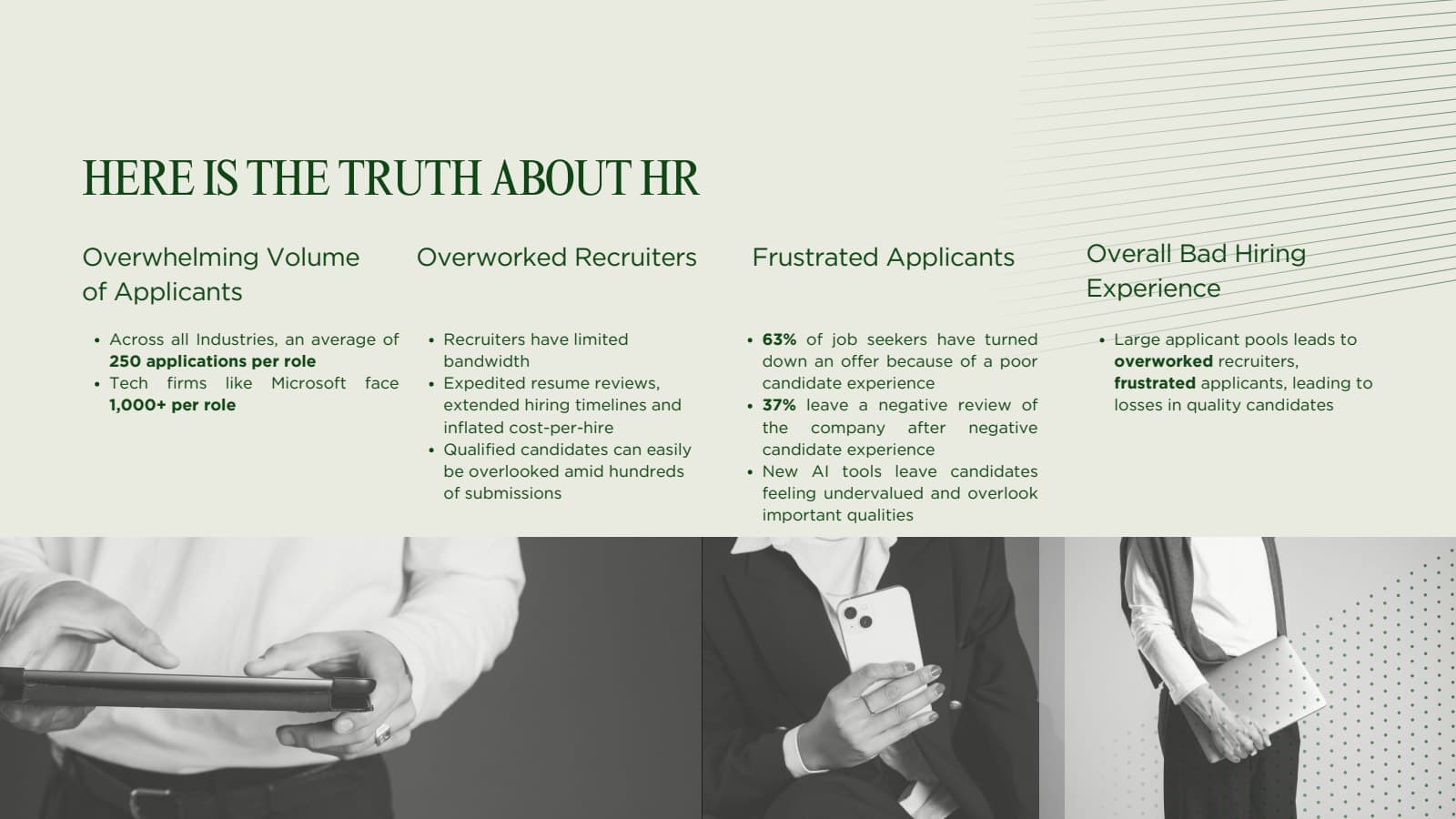
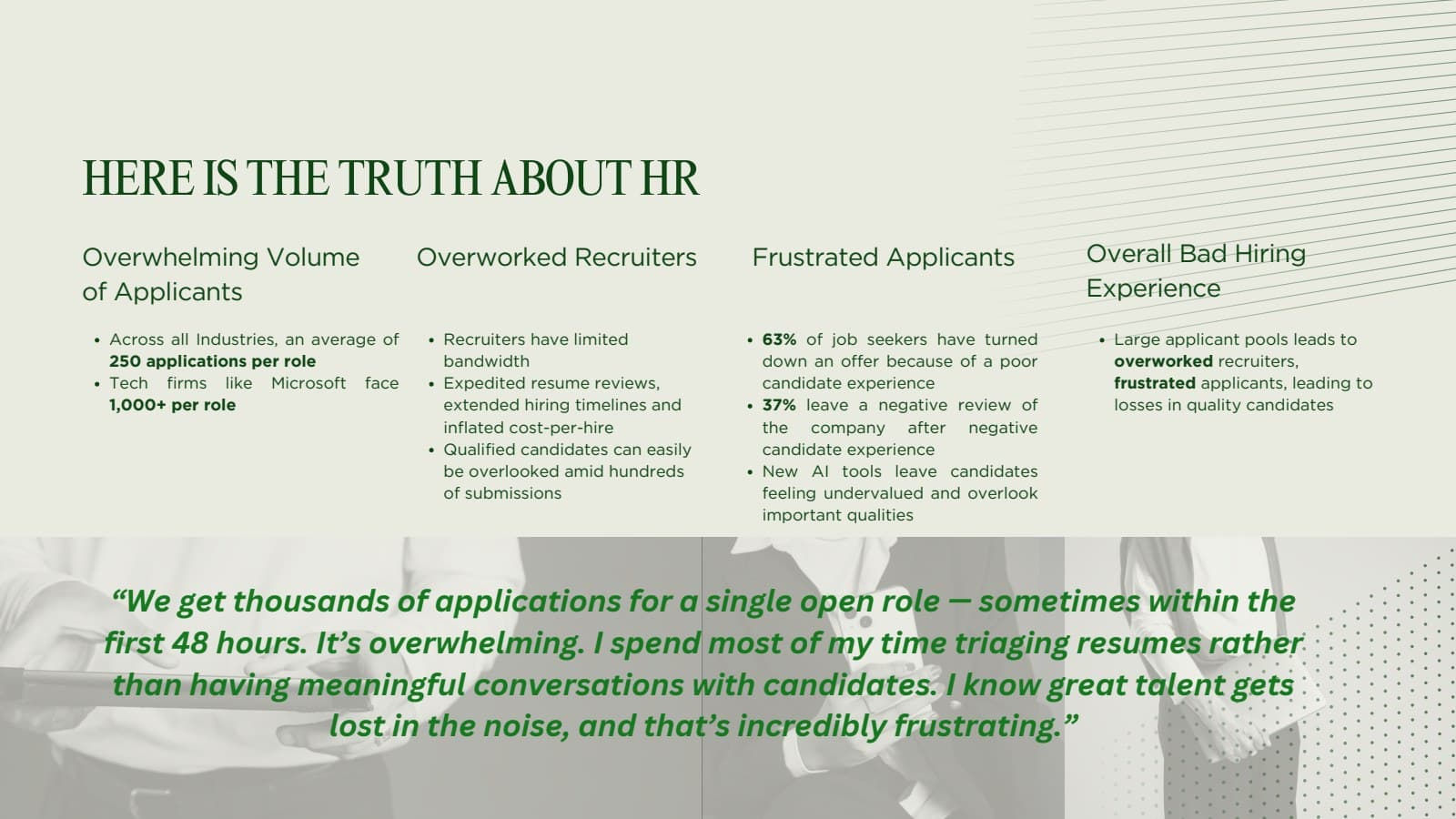
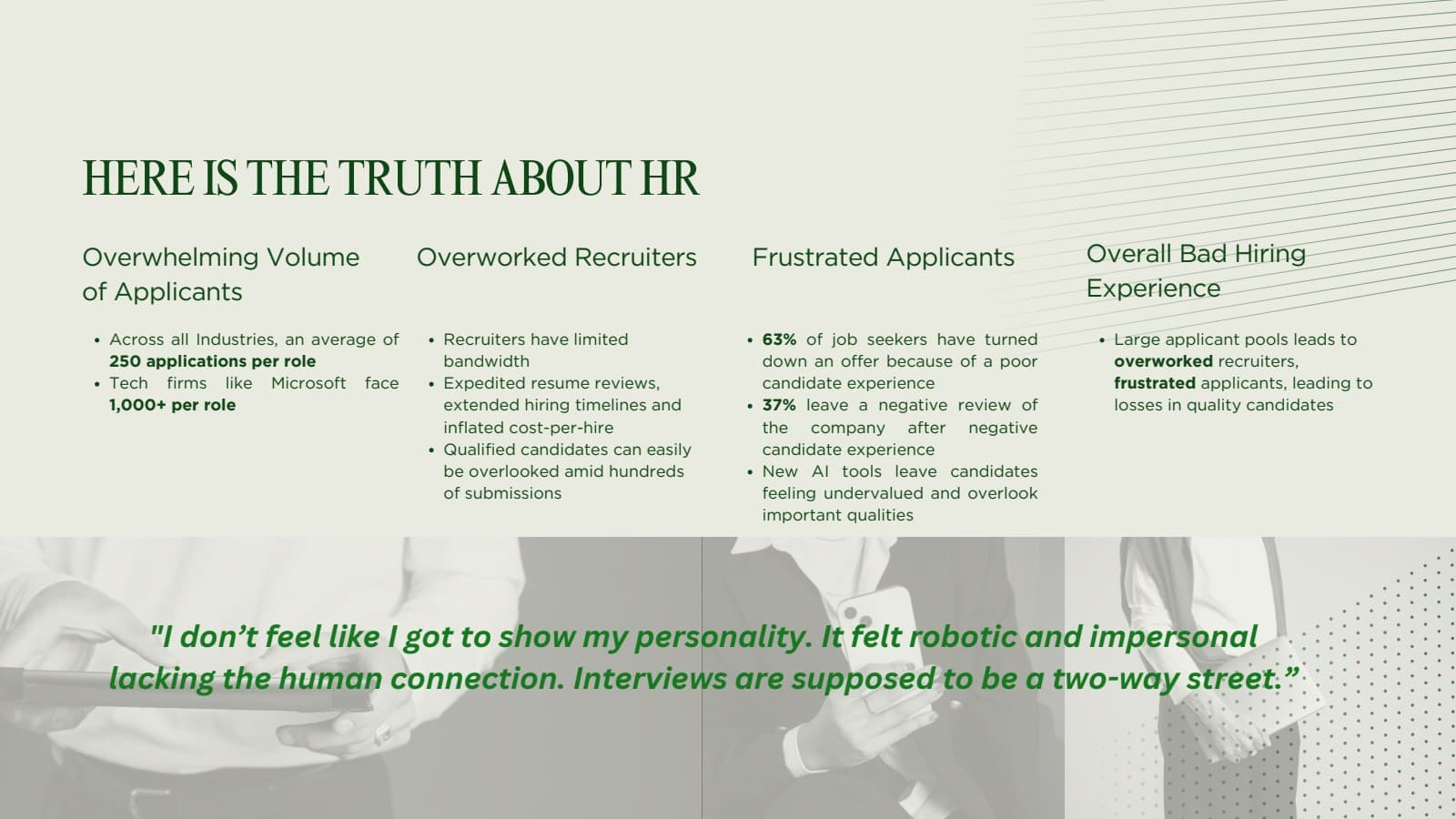
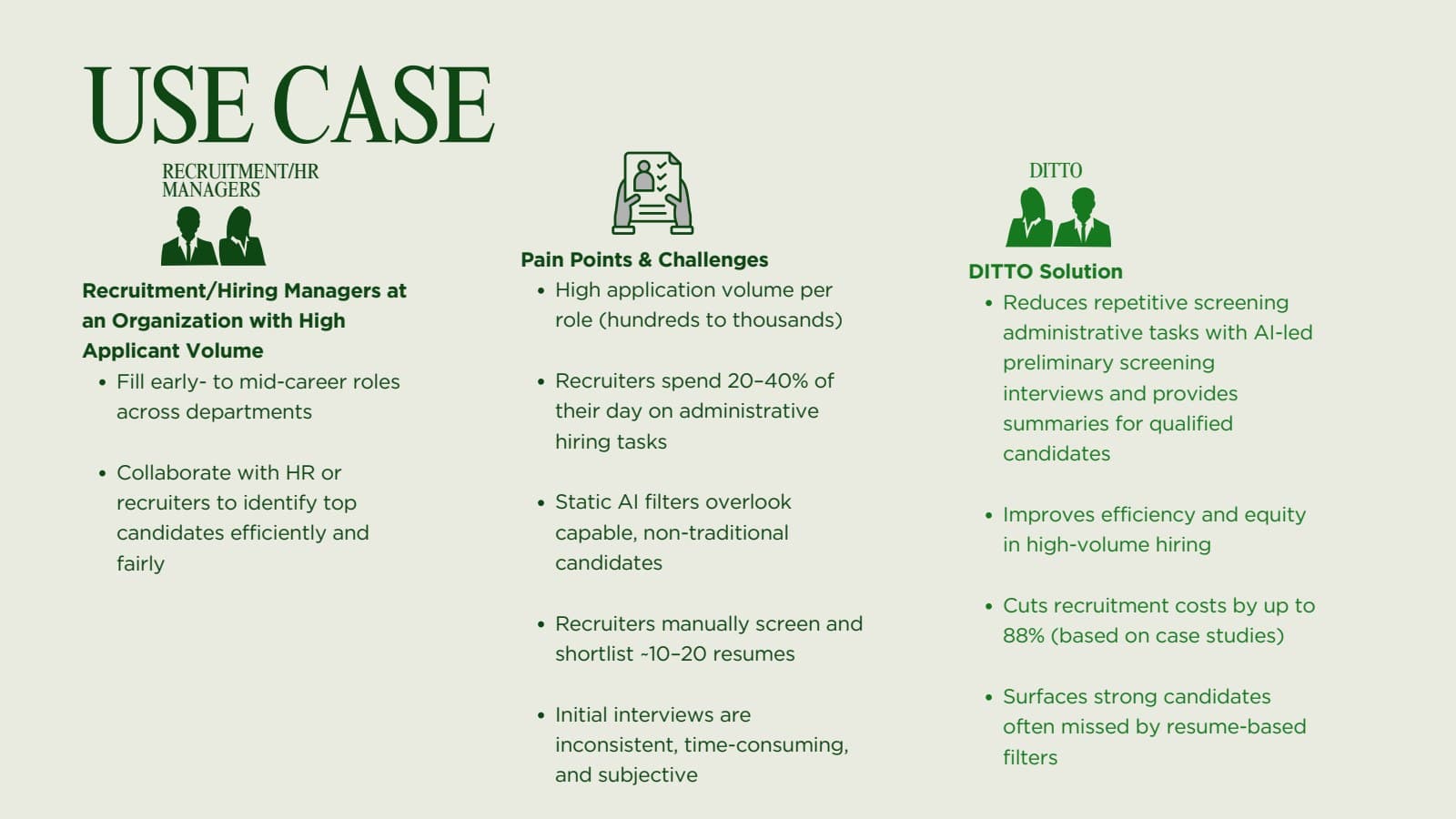
Our team focused on early recruiting conversations. Recruiters faced large application pools and limited time for individual conversations, while candidates had little opportunity to show more than a resume. A personalized hiring-manager agent offered a specific application for Ditto’s ability to represent someone in a conversation.
We proposed using that agent for preliminary interviews: asking consistent questions, answering approved questions about the role, and returning a useful summary to the recruiter. The business case depended on giving recruiters more time for promising candidates while making the first interaction more informative for applicants.
Designing for both sides of the conversation
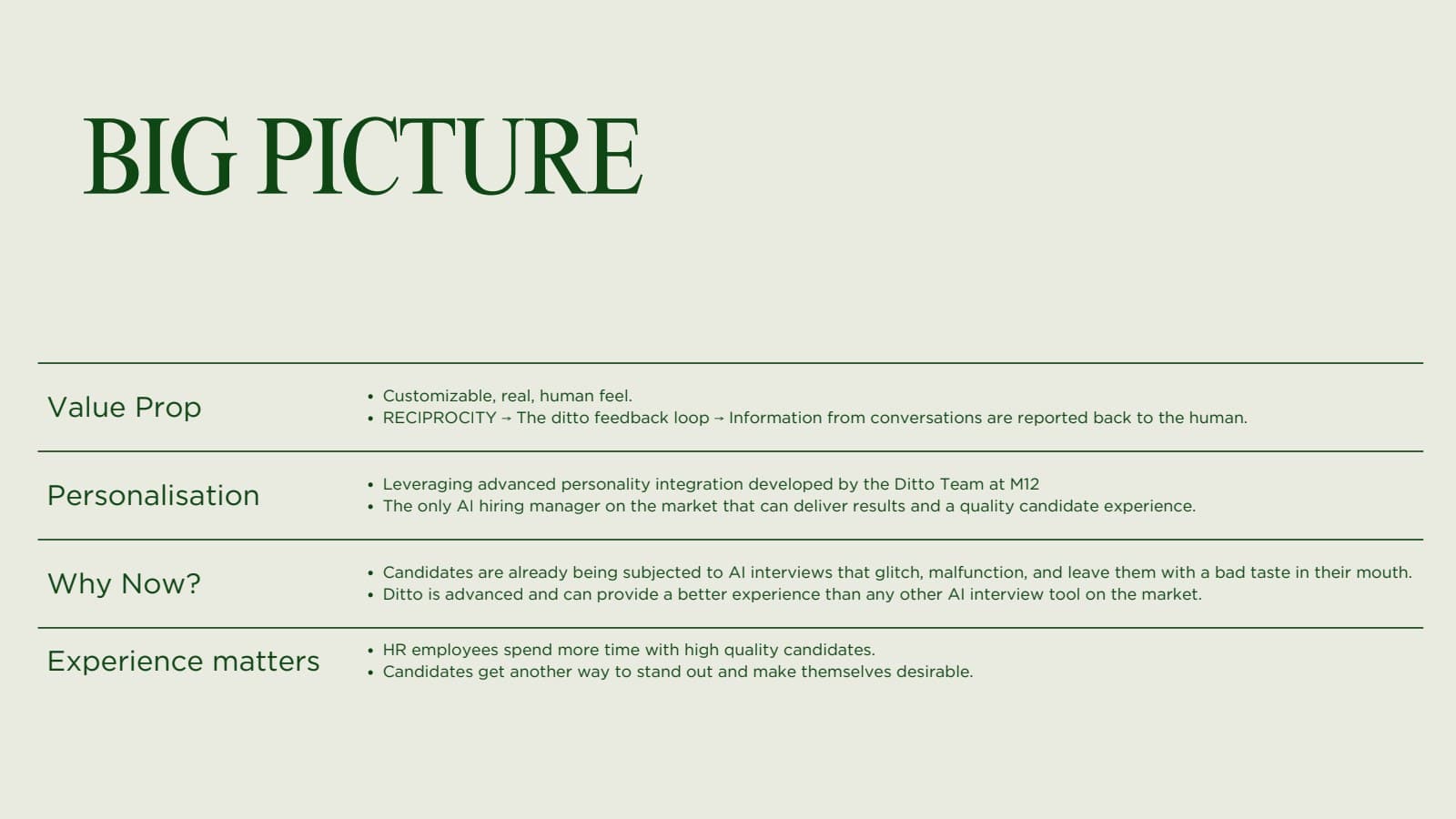
The proposed value went beyond handling a higher volume of interviews. Candidates would have another way to explain their experience and ask questions, while recruiters would receive a summary to help decide who to spend time with next.
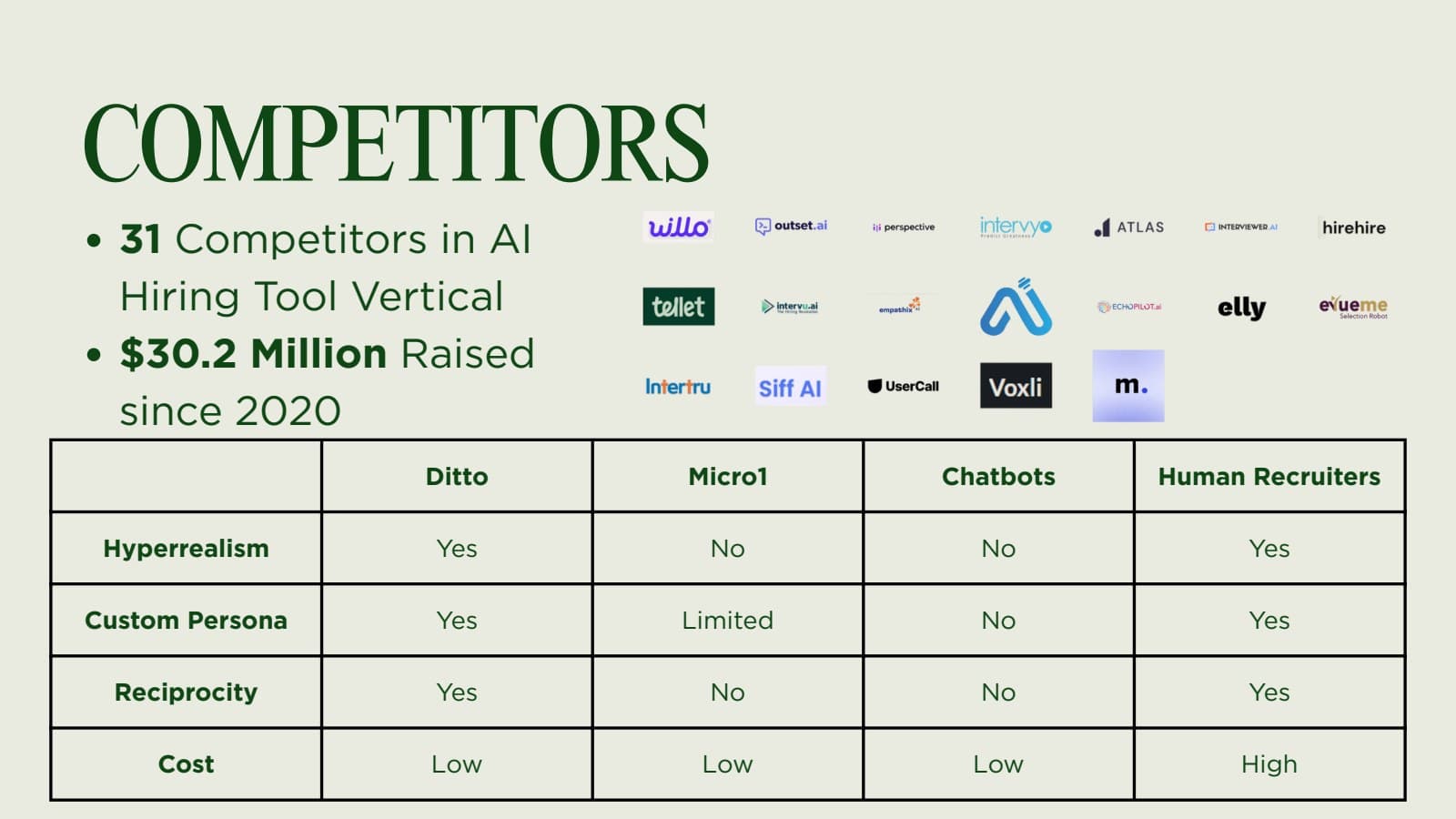
We centered the concept on personalization and reciprocity: the agent would reflect the hiring manager, and what it learned from a candidate would return to the human recruiter. The intended role was an initial screening conversation that supported later human interviews.
The key hypothesis: could it screen for company culture?
One of our most important success hypotheses was whether Ditto could help screen for the culture part of a company. A resume can describe experience, but it tells a hiring team much less about how someone collaborates, handles feedback, or approaches the day-to-day expectations of a workplace. We believed that a useful conversation about those dimensions could make the recruiting application much more valuable.
The opportunity was two-way. A candidate could learn about the team’s working style, while the hiring team could receive concrete examples of how the candidate preferred to work. If Ditto could surface that information reliably, we believed it would be a strong reason for a company to adopt the product.
That hypothesis would need careful definition and testing. “Culture” would have to mean explicit, job-relevant behaviors and expectations, rather than similarity to the interviewer or a vague personality score. The agent’s summary would need to show the evidence behind its observations and leave the hiring decision with people. We did not validate an automated culture-screening capability in the course project.
What would have to work for the business to succeed
Personalization had to be useful beyond appearance. The agent would need an accurate understanding of the hiring manager, role, and team, stay within approved information, and acknowledge questions it could not answer. A convincing avatar alone would not establish that it could conduct a useful interview.
Reciprocity was central to our pitch: what the agent learned had to return to the human recruiter in a clear, accurate, actionable form. Interview summaries needed to preserve a candidate’s meaning and connect observations to the role’s requirements so the next human conversation could build on them.
Candidate trust and workflow adoption were equally important. Applicants needed to know they were speaking with an AI agent, understand how their information would be used, and have a route to a person. Recruiters needed the output inside their applicant-tracking workflow, without creating another system to maintain.
The proposed pilots would need to test recruiter time saved, candidate experience, summary accuracy, and the usefulness of the screening conversation. Culture-related screening would also need checks for bias and accessibility. Those were conditions for making the concept credible, not results we had already demonstrated.
Making the commercial case
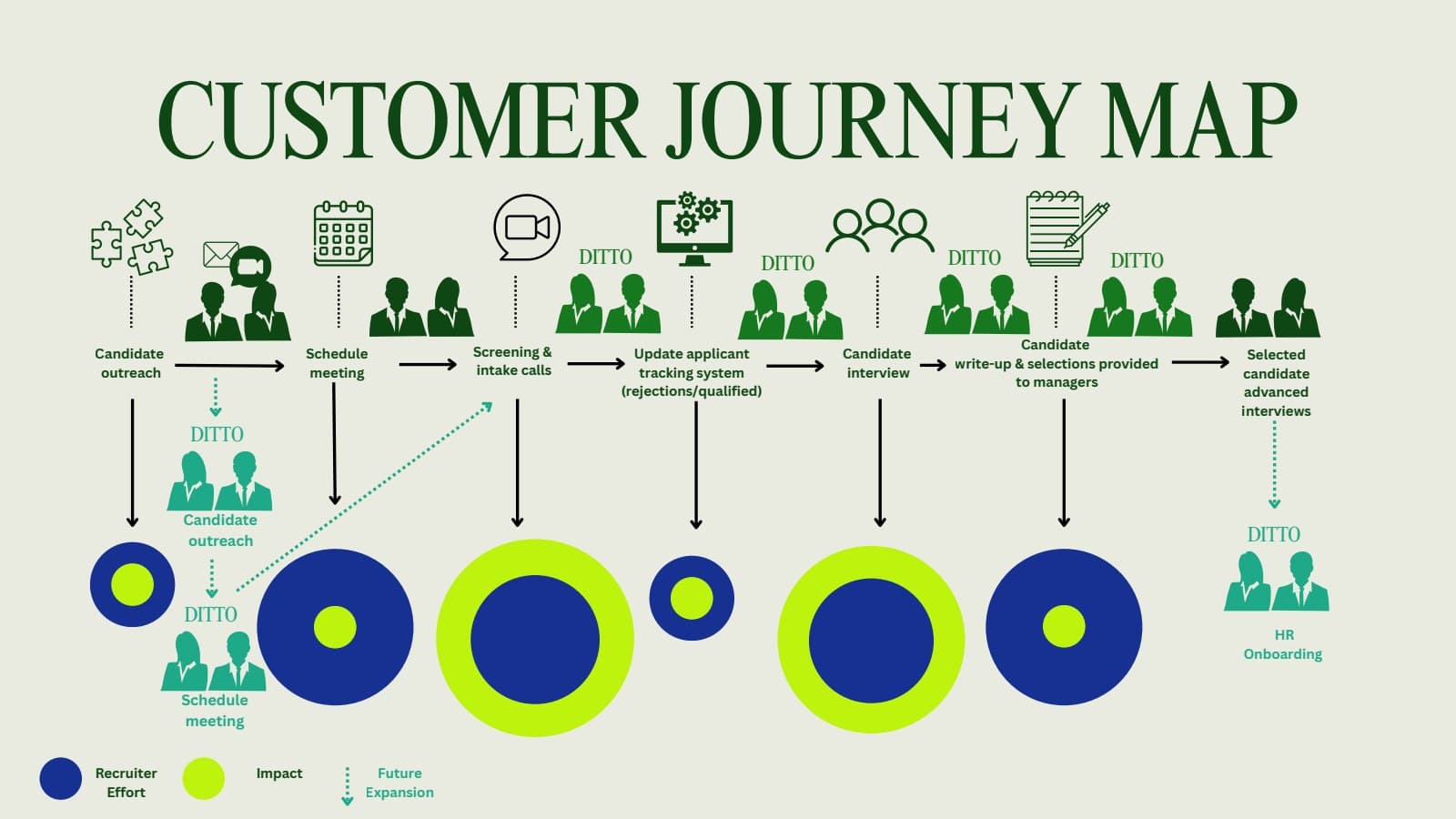
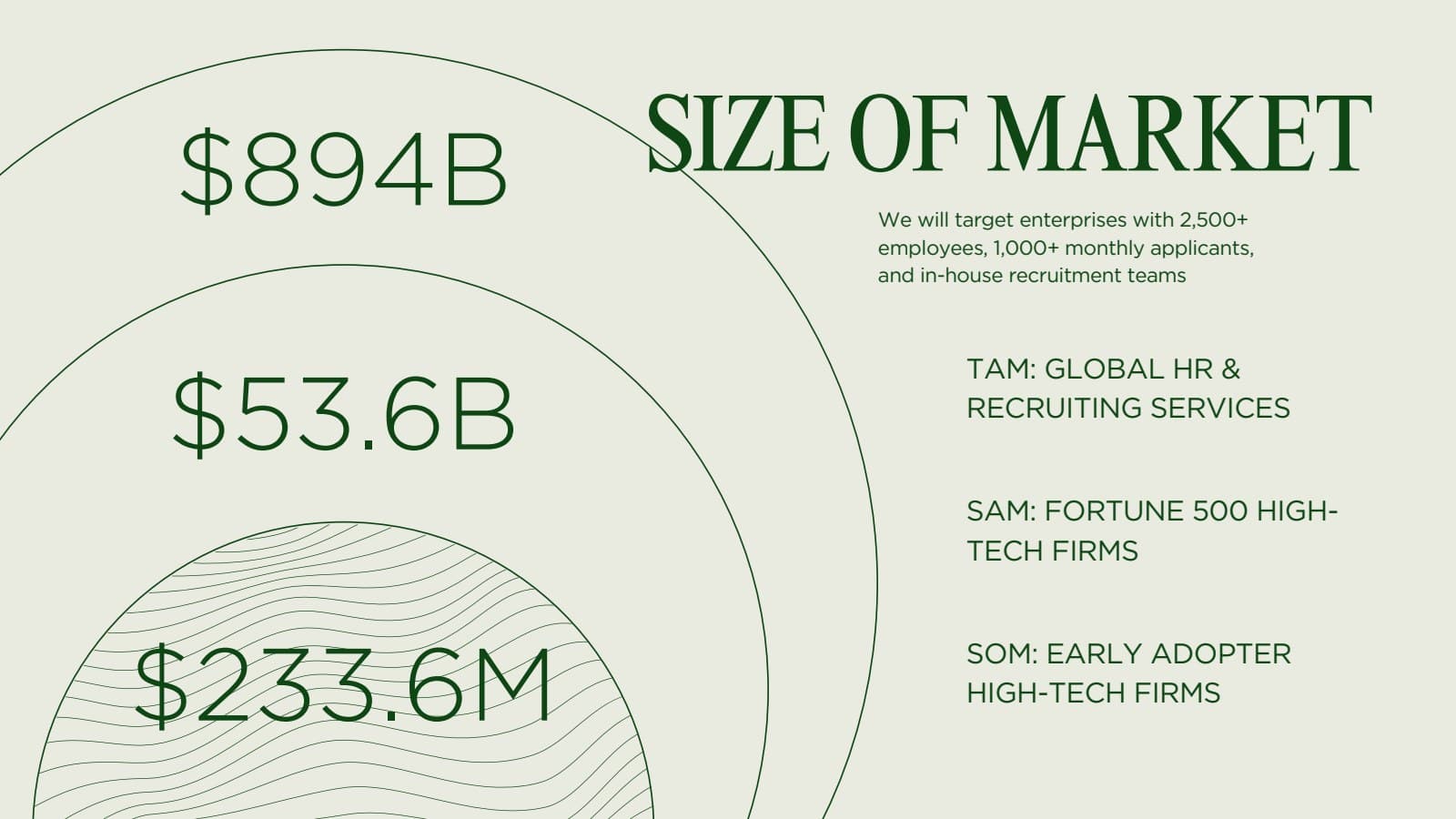
We defined an initial customer segment of large technology employers with in-house recruiting teams and high application volumes. The work covered the customer journey, market sizing, alternatives, and positioning against human recruiters and other AI interview tools.
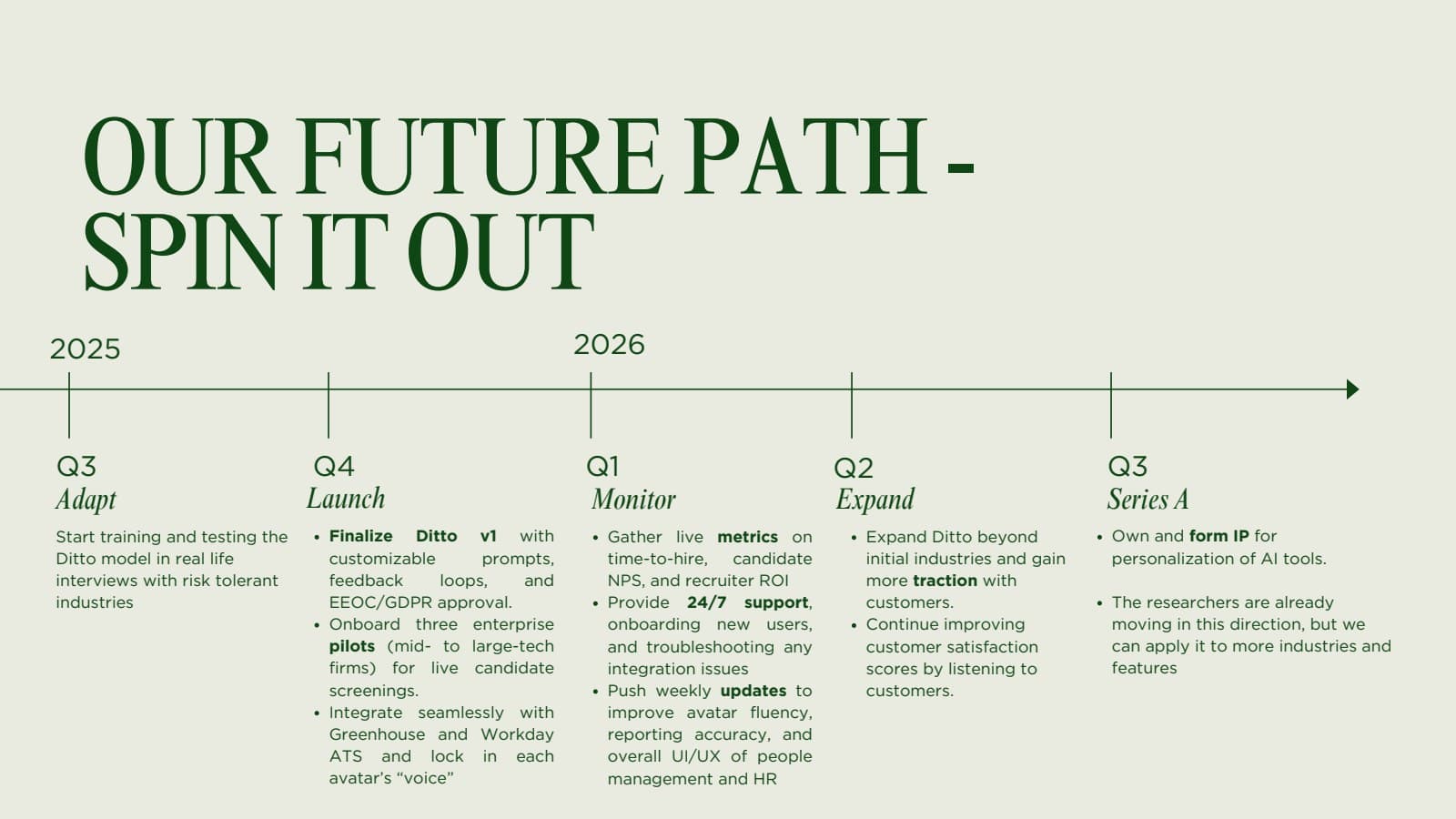
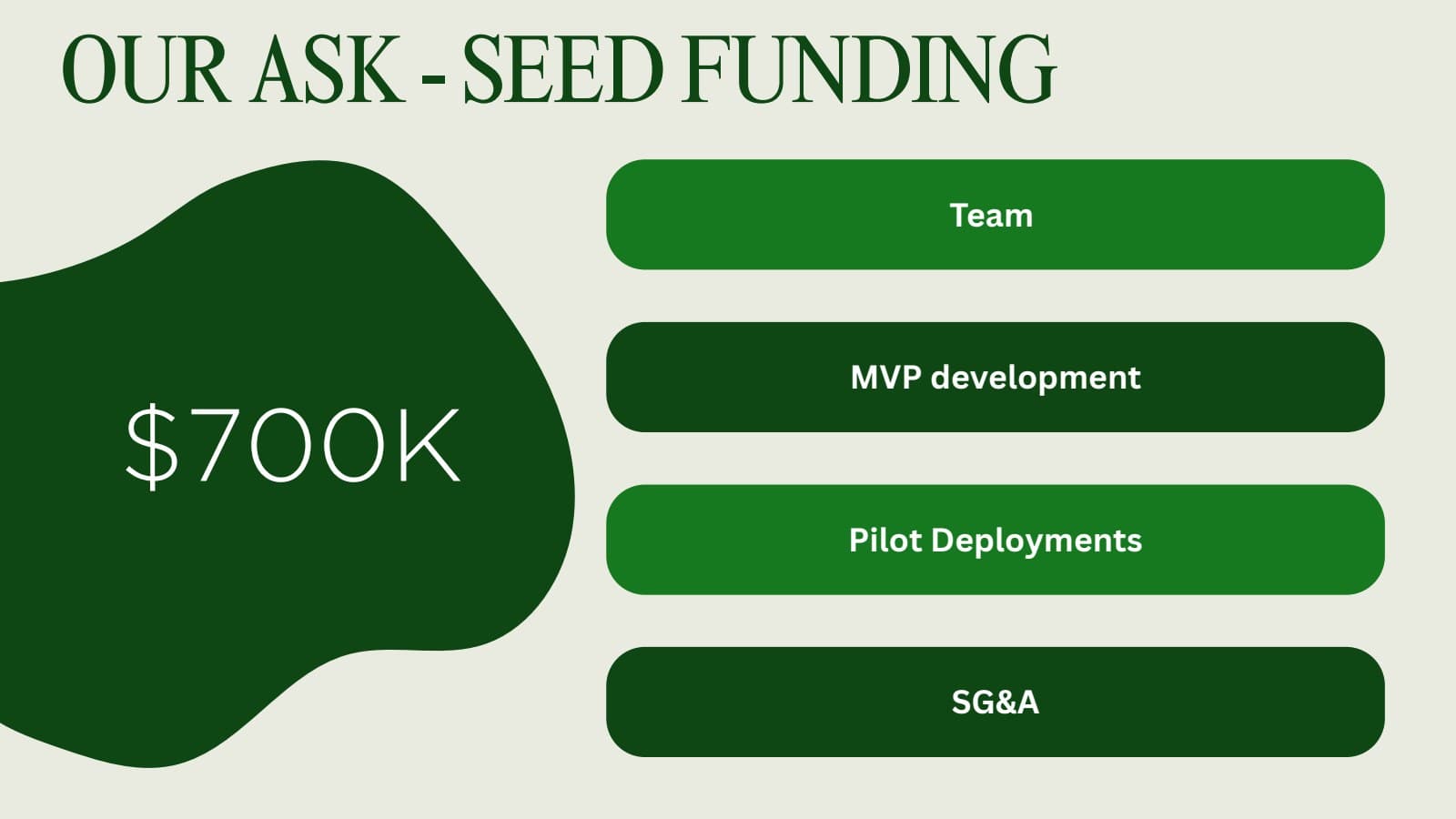
Our proposed roadmap moved from product adaptation to enterprise pilots, feedback, and broader expansion. We identified candidate experience, recruiter effort, and integration with applicant-tracking systems as things the product would need to address. The pitch included a proposed $700,000 seed funding ask for the team, MVP development, pilot deployments, and operating expenses.
My contribution
I interviewed recruiters and HR managers to understand their pain points and challenges in the hiring process. I synthesized those conversations to help refine our value proposition: where Ditto could be useful, which problems it should address, and how it could support recruiting teams and candidates.
As a team, we also interviewed the researchers directly to better understand the technology and inform our proposed business application. I helped develop the fundraising ask and the case for how the proposed $700,000 would support MVP development, pilot deployments, and operating expenses.
The work was a commercialization exercise around existing technology. The recruiting application, pilots, funding ask, and expansion timeline were our team’s proposals.
What I learned
A technology can support many use cases, but a commercial proposition has to choose one. For Ditto, that meant being specific about the recruiting step we wanted to improve and what a better experience would mean for candidates as well as hiring managers.
The commercialization pitch
Our course presentation covers the recruiting use case, customer journey, market analysis, positioning, and proposed path to a spinout. Market figures, benefits, and milestones are estimates and proposals from the course project.