
EXPERIENCE
Runic.AI
AI GTM Automation Consultant
Mar – Jun 2026 · Boston, MA · Remote
200% increase in qualified leads
Consulting engagement with a portfolio company of the venture fund run by my Angel Investing Practicum professor.
Built and shipped an agentic lead-generation pipeline, from product requirements through deployment, that increased qualified leads by 200%.
Built with
 Claude Code
 Python
 GitHub Actions
 cron-job.org
 Gemini
 Lovable
 React
 Supabase
 Cloudflare Workers
How it started
I met Runic’s founder through my Angel Investing Practicum professor, who runs a venture fund with Runic in its portfolio. On our first call, we identified where I could help. I then wrote an initial PRD (product requirements document) that captured his goals and the constraints and pain points we were targeting, and I scoped what the consulting contract would cover.
Who I talked to
I worked directly with Runic’s founder over about ten calls, from the first scoping conversation through handover.
WHAT THE FOUNDER NEEDED
His time is valuable, and he wanted actionable information, not raw research.
HOW I BUILT FOR IT
Every Monday he gets one short email with 20 ranked leads. Each lead has a fit score with a reason, a LinkedIn link, recent news, and a one-sentence pitch.
WHAT THE FOUNDER NEEDED
The best early buyers were VP-level leaders in consumer insights, followed by marketing and product marketing, ideally one to three years into the role.
HOW I BUILT FOR IT
I turned that into the scoring rubric: seniority combined with department, tenure as the tiebreaker, and anyone under 5 out of 10 filtered out.
WHAT THE FOUNDER NEEDED
The signals worth acting on were company news from the last one to three months, new products, and CEO mandates around AI.
HOW I BUILT FOR IT
The weekly email pulls recent news for each lead and turns it into a tailored one-line pitch.
WHAT THE FOUNDER NEEDED
He wanted 10 to 20 strong leads a week, not an exhaustive list.
HOW I BUILT FOR IT
The pipeline enriches about 40 candidates each week and sends only the best 20, which keeps Apollo credit use low.
WHAT THE FOUNDER NEEDED
After the first emails, he said they were in good shape and asked for more context on how Runic could help.
HOW I BUILT FOR IT
Each lead now ends with a pitch tailored to that person. I also fixed the email timing and added automatic company discovery so the pool refills when it runs low.
WHAT THE FOUNDER NEEDED
For events, he wanted 30 to 50 options with senior attendees in marketing, advertising, and market research.
HOW I BUILT FOR IT
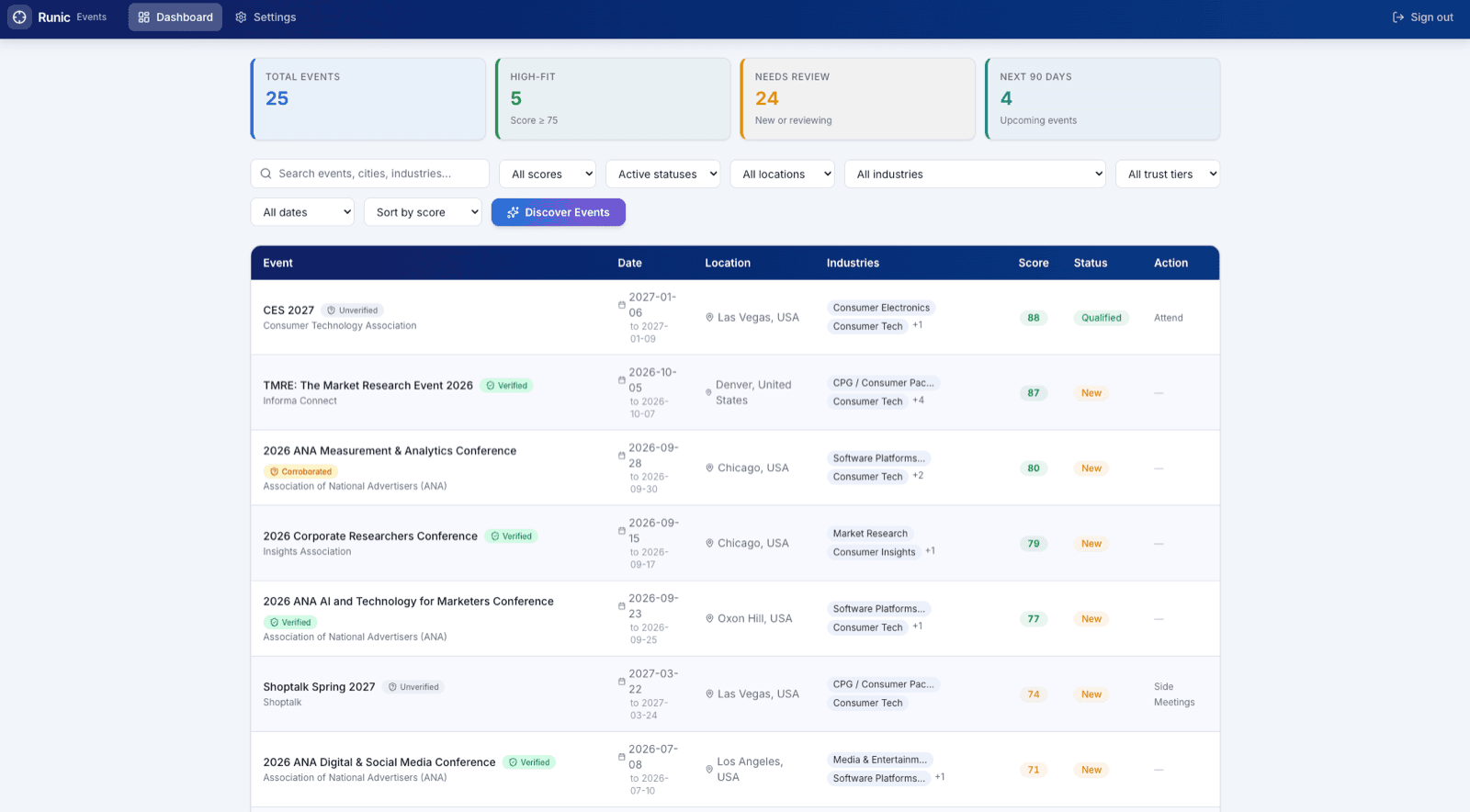
The conference finder scores every event against Runic’s profile and shows how well each one is verified.
The goals and the scope
We agreed on two goals. The first was to find opportunities to start sales conversations, from conferences where Runic could market itself to recent company news that gave the founder a timely reason to reach out. The second was to identify senior leaders at target accounts.
I scoped the minimum viable product in stages. The first covered target-account intake, the ideal customer profile and role preferences, and automated identification of likely senior stakeholders at each account. Later stages called for monitoring recent events at those accounts, scoring and ranking opportunities, founder-ready briefs with outreach angles, feedback controls, and a daily email digest.
Choosing how to build it
I compared app builders like Lovable, Replit, and Bolt.new; automation tools like n8n, Zapier, Make, Gumloop, and Airtable; Perplexity Computer; and coding agents like Claude Code and Cursor. My priorities were getting a first version in front of the founder, keeping costs low, and having enough control to build out the workflows.
Lovable was a useful starting point for the website and front end, and I was more familiar with it than Replit or Bolt.new. I built the first prototype there. As I got into the data collection, scoring, and automation, I wanted more technical depth and control over the implementation, so I moved the code into Claude Code and continued building there.
This was my first time using n8n, though I already knew about it, Zapier, Make, and Gumloop. I tried Gumloop but decided against keeping it because it added another paid layer on top of the services we would already use. I wanted to see whether I could build the workflow without that premium.
I also tried Perplexity Computer while it was still in its early stages to see what it could do. I was not satisfied with the work it produced for this project, so I continued with Claude Code after the Lovable prototype.
LinkedIn was my first choice for finding people, but connecting it to an automated workflow through an API was difficult. I also considered contact databases such as Apollo, ZoomInfo, Coresignal, and Clay. Apollo made sense because the fund already paid for a subscription and was not using its full capacity. Using that existing subscription kept the project cost-effective.
For timely sales signals, I considered company newsrooms, press releases, Google News, conference speaker lists, and hiring signals. The lead pipeline became a lean Python system, while the Lovable prototype became the front end for the conference finder.
Tool one: weekly lead generation
I built the lead pipeline in Python with Claude Code. Every Saturday it searches Apollo for senior marketing and consumer-insights leaders at Runic’s target brands, using about 30 job titles and seniority filters. A rule-based filter drops junior titles, and an LLM scores each remaining person from 0 to 10 with a written reason.
On Monday morning, it enriches the 40 strongest leads not yet sent with LinkedIn profiles, employment history, and recent company news, scores them again, and emails the founder the best 20. A Google Sheet keeps every lead so nobody is sent twice, and a separate job finds new companies to research when the list runs low.
cron-job.org triggers the scheduled workflows on GitHub Actions. Apart from the Apollo subscription the fund already paid for and was not using in full, the pipeline runs on free tools and free LLMs, putting more of that existing subscription to work.
Tool two: the conference finder
For the first goal, I built an event intelligence tool. I started it from a Lovable template and built it out with Claude Code. It searches the web with Firecrawl, then uses Gemini to pull out conferences only from the pages it actually fetched, so it can’t invent events.
Code then checks each event’s dates, links, and year, labels it verified, corroborated, or unverified, and scores it from 0 to 100 against Runic’s ideal customer profile with a plain-language breakdown. The founder can edit that profile directly or through an AI chat.
Iterating with the founder
While building, I tested approaches with different tools, went back and forth with the founder, gathered his feedback, and iterated before delivering both tools and handing them over.
Challenges along the way
Keeping the lead pipeline running as free models were retired
The pipeline scores leads with free LLMs on Groq, and those models change. I tested candidate models on real scoring prompts and moved the pipeline from Llama 3.1 to Llama 4 Scout, then to Qwen, then to GPT-OSS 120B as models were retired.
After one preview model disappeared and a weekly run hit 192 failed calls, I switched models and confirmed the fix with a 116-call test that returned no empty or cut-off responses.
Working within rate limits on the conference finder
Groq, the first AI provider I moved the conference finder to, kept hitting its limit of 12,000 tokens per minute. I shrank the page excerpts, processed one page at a time, and added retries that wait as long as the API asks.
When that still wasn’t enough, I switched to Gemini, which has far more headroom. That let me go back to longer excerpts and batches of five pages, cutting each discovery run from 30 requests to 6.
Protecting the Apollo credits
Enriching a lead costs one Apollo credit, so the pipeline only enriches the 40 strongest candidates each week. Low-scoring leads stay on file as filtered, so they are never evaluated or paid for twice.
Making failures visible
If Apollo, the LLM, or Google Sheets fails, the run retries with backoff. A dead API key stops the run and sends an alert email instead of failing silently.
The PRD in detail
User stories
- As a founder, I want to upload a list of target accounts so the system can proactively monitor them for relevant people and events.
- As a founder, I want the system to identify likely senior decision-makers so I can avoid manual account research.
- As a founder, I want recent trigger events surfaced automatically so I have a timely reason to reach out.
- As a founder, I want a concise account brief with suggested messaging so I can move directly into outreach.
- As a founder, I want only the highest-signal opportunities shown first so my daily review takes very little time.
Functional requirements
- Account intake (P1): create and maintain a target-account list by manual input or CSV upload, store company name, website, segment, status, priority, and notes, and exclude accounts already in active conversation or out of scope.
- ICP and role configuration (P1): define and edit ideal customer profile criteria, including target company characteristics and preferred stakeholder functions.
- Contact identification (P1): find one or more likely senior leaders per account, each with a confidence score, name, title, company, function, source, and relevance rationale, ranked by likely influence.
- Event detection (P2): detect recent public events at target accounts, such as leadership changes, funding, partnerships, product launches, hiring, and expansion, and store each with type, date, summary, source, and relevance score.
- Opportunity scoring (P2): combine account fit, contact seniority, event freshness, event relevance, and source confidence into one score, explained in plain language.
- Founder briefs (P3): for each top opportunity, a brief with the recommended contact, why they matter, the trigger event, why it matters now, an outreach angle, two or three talking points, a confidence level, and source links.
- Digest and alerts (P3): a short, ranked, skimmable digest of the top opportunities through email or Slack.
- Feedback loop (P3): mark recommendations as useful, not useful, contacted, or ignored, and keep that feedback to improve ranking later. This one was scoped but not built.
Success metrics
- North star: the percentage of meetings booked that came from product-sourced opportunities.
- Signal to noise: the percentage of delivered briefs the founder rejects or marks irrelevant.
- The percentage of accounts with at least one high-confidence senior contact.
- The percentage of accounts with at least one relevant recent trigger event.
My contribution
- Wrote the PRD with the founder: goals, scope, user stories, functional requirements, and success metrics.
- Built a weekly lead-generation pipeline that finds senior marketing and consumer-insights leaders through Apollo, scores them with an LLM, and emails the founder the top 20 every Monday.
- Built a companion tool that finds and scores industry conferences for Runic to market at.
- Tested candidate LLMs on real scoring prompts and kept the pipeline running on free tiers as models were retired.